



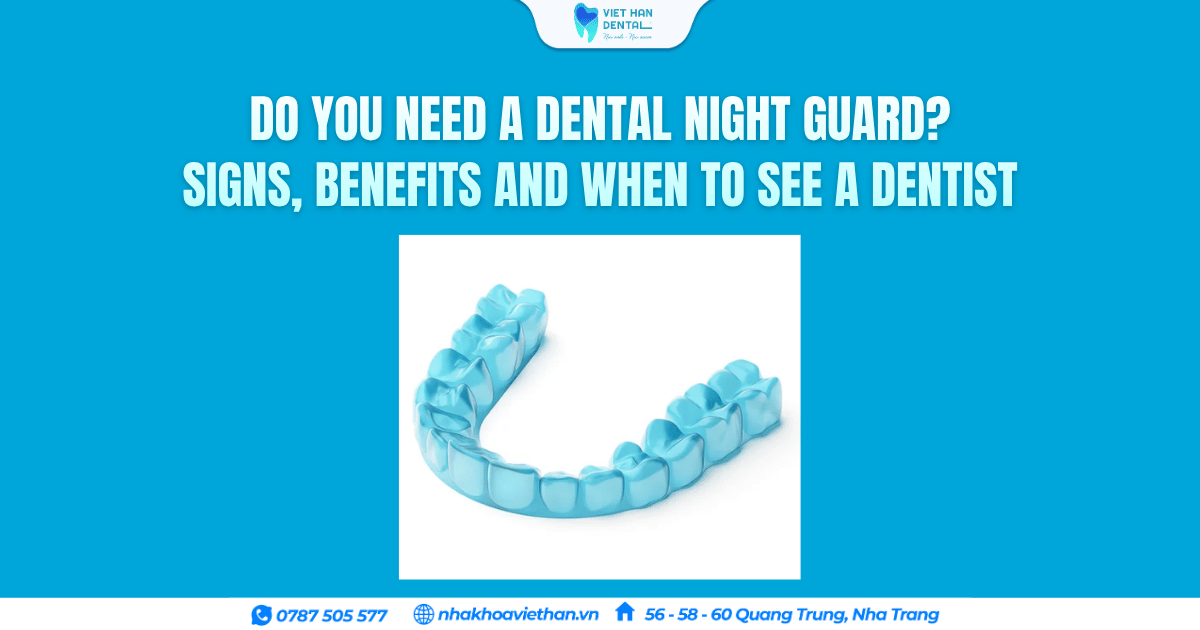
Do you often wake up with a tired jaw, sensitive teeth or a dull headache around the temples? Have you noticed that your teeth are becoming flatter, chipped or increasingly worn?
These signs may be related to bruxism — involuntary clenching or grinding of the teeth, particularly during sleep.
For some patients, a dentist may recommend a custom dental night guard to reduce excessive contact between the upper and lower teeth and help protect the teeth and dental restorations from repeated biting forces.
At Viet Han Dental Clinic in Nha Trang, night guards are recommended only after the patient’s teeth, bite and jaw condition have been carefully assessed.
Nội dung
- What Is a Dental Night Guard?
- What Is Bruxism?
- Signs You May Be Grinding Your Teeth at Night
- Why Can Teeth Grinding Become a Problem?
- Cracked or Chipped Teeth
- Tooth Sensitivity
- Jaw Muscle Fatigue
- Morning Headaches
- Bruxism and the Temporomandibular Joint
- 1. Helps Protect Tooth Enamel
- 2. Helps Reduce Stress on Teeth
- 3. Protects Crowns, Veneers and Bridges
- 4. Helps Protect Cosmetic Dental Work
- 5. May Reduce Morning Muscle Discomfort
- Who May Benefit From a Night Guard?
- Over-the-Counter Guards
- Custom Dental Night Guards
- Step 1: Dental Examination
- Step 2: Digital Scan or Impression
- Step 3: Appliance Design
- Step 4: Fitting and Adjustment
- When Should a Night Guard Be Replaced?
What Is a Dental Night Guard?
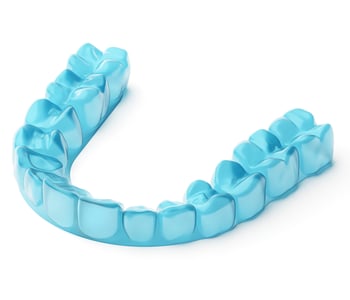
A dental night guard, also known as an occlusal guard, bite guard or occlusal splint, is a removable oral appliance generally worn while sleeping.
Unlike generic mouthguards purchased over the counter, a professionally made night guard is designed according to the shape of your teeth and your individual bite.
Depending on the treatment objective, it may be fitted over either the upper or lower teeth.
The appliance creates a protective surface between the two dental arches. Instead of the teeth repeatedly rubbing or pressing directly against one another during clenching or grinding, some of these forces are distributed through the guard.
Its main purpose is therefore not to “stop” every grinding movement, but to help protect the teeth and restorations from excessive wear and mechanical stress.
What Is Bruxism?
Bruxism refers to repetitive jaw-muscle activity that may involve:
- Clenching the teeth
- Grinding the teeth
- Pressing the jaw together
- Repetitive jaw movements
Some people clench their teeth while awake, particularly during periods of concentration or stress. Others grind their teeth during sleep and may have no idea that it is happening.
In fact, a patient may first become aware of the problem when a partner hears grinding sounds at night or when a dentist notices characteristic patterns of tooth wear during an examination.
Signs You May Be Grinding Your Teeth at Night
Bruxism does not always cause obvious symptoms. However, possible signs include:
- Flattened or worn biting surfaces
- Chipped or cracked teeth
- Increasing tooth sensitivity
- Tight or tired jaw muscles in the morning
- Jaw discomfort
- Pain around the temples
- Frequent morning headaches
- Marks along the sides of the tongue
- Damage to crowns, veneers or other restorations
- A partner noticing grinding sounds while you sleep
Having one of these symptoms does not automatically mean that you have bruxism.
A dental examination is important because similar symptoms can have other causes.
Why Can Teeth Grinding Become a Problem?
Your teeth are designed to withstand normal chewing forces. However, prolonged or repetitive clenching can place substantially more pressure on the teeth, muscles and dental restorations.
Over time, excessive forces may contribute to several problems.
Tooth Wear
Repeated grinding can gradually wear away the outer enamel surface.
As enamel becomes thinner, teeth may appear:
- Shorter
- Flatter
- More yellow
- More sensitive
- Uneven along the edges
Severe wear may eventually expose deeper layers of the tooth.
Cracked or Chipped Teeth
Repeated heavy biting forces can increase stress on natural teeth.
Teeth with large fillings, previous root canal treatment or existing structural weaknesses may be particularly vulnerable to fractures.
Small chips can also develop gradually along the biting edges.
Tooth Sensitivity
When enamel becomes worn or damaged, the underlying tooth structure may become more exposed.
Patients may begin noticing sensitivity to:
- Cold drinks
- Hot foods
- Sweet foods
- Pressure when chewing
Persistent sensitivity should always be assessed by a dentist rather than assumed to be caused by grinding alone.
Jaw Muscle Fatigue
Imagine keeping another muscle in your body contracted for hours at a time.
A similar process may occur when someone repeatedly clenches their jaw during sleep.
This can leave the chewing muscles feeling:
- Tight
- Tired
- Tender
- Stiff
Some patients notice these symptoms most strongly immediately after waking.
Morning Headaches
Muscle tension associated with clenching may contribute to headaches around the temple or jaw area in some patients.
However, headaches can have many different causes.
If headaches are frequent, severe or changing in pattern, appropriate medical assessment may also be necessary.
Bruxism and the Temporomandibular Joint
The temporomandibular joints, commonly called the TMJs, connect the lower jaw to the skull.
Excessive clenching may place additional load on the jaw muscles and joints in certain patients.
Possible symptoms around the jaw joint can include:
- Jaw tenderness
- Pain during chewing
- Clicking or popping
- Difficulty opening the mouth comfortably
- Muscle tightness
- Jaw fatigue
A night guard may form part of the management plan for selected patients, but TMJ disorders have many possible causes and should be properly assessed before treatment is recommended.
A night guard is not suitable for every type of jaw-joint problem.
Benefits of a Custom Dental Night Guard
When appropriately prescribed, a night guard can offer several important protective benefits.
1. Helps Protect Tooth Enamel
One of the primary purposes of a night guard is to prevent the upper and lower teeth from directly grinding against each other.
The appliance provides a protective layer between the dental arches and may reduce further mechanical wear.
This can be especially valuable for patients who already show visible signs of enamel loss.
2. Helps Reduce Stress on Teeth
A custom night guard can help distribute biting forces across a broader surface rather than concentrating pressure on individual teeth.
This may help reduce the risk of additional chipping or excessive tooth wear associated with nighttime grinding.
3. Protects Crowns, Veneers and Bridges
Bruxism is particularly important to consider for patients who have undergone restorative or cosmetic dental treatment.
Repeated grinding can place stress on:
- Porcelain crowns
- Dental veneers
- Dental bridges
- Large fillings
- Implant-supported crowns
Even strong dental materials are not indestructible.
A night guard may therefore be recommended after restorative treatment when the dentist identifies significant clenching or grinding.
4. Helps Protect Cosmetic Dental Work
Patients who have invested in smile restoration naturally want their results to remain stable for as long as possible.
For individuals who grind their teeth, protecting veneers or porcelain crowns is particularly important because excessive forces can contribute to:
- Chipping
- Fracture
- Debonding
- Accelerated wear
- Changes in the bite
A professionally designed guard can become an important part of long-term maintenance after cosmetic dental treatment.
5. May Reduce Morning Muscle Discomfort
By modifying the way the teeth contact during sleep, an occlusal appliance may help reduce muscle strain for some patients.
Patients may notice improvement in symptoms such as jaw tightness or morning muscle fatigue.
Results vary depending on the underlying cause, which is why proper diagnosis is important.
Night Guards After Dental Implant Treatment
Dental implants are designed to tolerate normal chewing forces once fully integrated and restored.
However, excessive clenching or grinding can place additional mechanical stress on implant-supported restorations.
For patients with significant bruxism, dentists may therefore recommend a protective appliance following implant treatment.
This is particularly relevant for patients with:
- Multiple implant crowns
- Implant-supported bridges
- Full-arch implant restorations
- All-on-4 or All-on-6 restorations
- A history of strong clenching
Protecting the prosthetic components from excessive loading can form part of a long-term implant maintenance strategy.
Who May Benefit From a Night Guard?
A dentist may consider recommending a night guard if you:
- Grind your teeth during sleep
- Frequently clench your jaw
- Have noticeable tooth wear
- Repeatedly chip or fracture teeth
- Wake with jaw fatigue
- Have restorations exposed to excessive bite forces
- Have undergone extensive crown or veneer treatment
- Have implant-supported restorations and significant bruxism
However, simply having a crown, veneer or Implant does not mean that you automatically need a night guard.
The decision should be based on your individual bite and clinical findings.
Custom Night Guard vs. Over-the-Counter Mouthguard
Patients sometimes ask whether a sports mouthguard or a boil-and-bite guard can be used instead.
Although these products may appear similar, they are not necessarily designed for the same purpose.
Over-the-Counter Guards
Generic guards are usually:
- Available in standard sizes
- Less accurately fitted
- Bulkier
- More likely to move during sleep
- Less precisely adapted to the patient’s bite
They may be suitable for temporary use in certain circumstances but should not automatically replace a professionally assessed occlusal appliance.
Custom Dental Night Guards
A custom guard is produced according to an impression or digital scan of your teeth.
This allows the dentist and laboratory to control:
- Fit
- Thickness
- Tooth contact
- Bite relationship
- Comfort
- Retention
The exact design depends on the purpose of the appliance.
How Is a Custom Night Guard Made?
The process is generally straightforward.
Step 1: Dental Examination
Before making the appliance, the dentist examines:
- Tooth wear
- Existing restorations
- Gum health
- Bite relationship
- Jaw movement
- Areas of excessive contact
The goal is to identify whether a night guard is appropriate and rule out other dental conditions that could be causing your symptoms.
Step 2: Digital Scan or Impression
A digital scan or dental impression is taken to record the precise shape of your teeth.
At Viet Han Dental Clinic, digital scanning can be used in suitable cases to create an accurate digital model of the dental arches.
Step 3: Appliance Design
The guard is designed according to your bite and clinical requirements.
The dentist determines whether it should be placed on the upper or lower teeth and how the opposing teeth should contact the appliance.
Step 4: Fitting and Adjustment
When the night guard is ready, the dentist checks:
- How firmly it fits
- Whether it feels comfortable
- How the teeth contact it
- Whether any areas need adjustment
Small adjustments may be made to achieve an appropriate bite relationship.
How to Care for Your Night Guard
Proper maintenance helps keep the appliance hygienic and extends its useful life.
After each use:
- Rinse the guard with cool or lukewarm water.
- Gently clean it with a soft toothbrush.
- Allow it to dry before placing it in its case.
- Store it in a ventilated protective container.
Avoid cleaning it with very hot water because heat may distort some appliance materials.
You should also bring your night guard to regular dental appointments so the dentist can check its fit and condition.
When Should a Night Guard Be Replaced?
There is no fixed lifespan for every appliance.
Replacement depends on:
- How strongly you grind
- The material used
- Changes in your bite
- Dental treatment completed after the guard was made
- Cracks or significant wear
- Loss of proper fit
Heavy grinders may wear through their appliances more quickly than other patients.
If you notice cracks, holes, distortion or loosening, bring the guard to your dentist for assessment.
A Night Guard Protects Your Teeth — But Diagnosis Comes First
A night guard can be extremely useful, but it should not simply be prescribed based on jaw discomfort alone.
Jaw pain, headaches, tooth sensitivity and worn teeth can arise from multiple conditions.
An accurate examination helps determine:
- Whether bruxism is present.
- Whether tooth damage has already occurred.
- Whether your bite contributes to the problem.
- Whether existing restorations need attention.
- Whether a night guard is appropriate for your particular situation.
In some cases, additional dental or medical evaluation may be necessary.
Custom Night Guards at Viet Han Dental Clinic in Nha Trang
If you regularly wake with jaw tightness, have visible tooth wear, repeatedly damage dental restorations or suspect that you grind your teeth during sleep, an examination can help identify the cause.
At Viet Han Dental Clinic, our dentists assess your teeth, bite, restorations and jaw condition before recommending an appropriate solution.
When a night guard is indicated, the appliance can be custom-made to fit your individual dental anatomy and provide greater comfort and protection during sleep.
Early intervention may help protect natural teeth as well as crowns, veneers, bridges and implant-supported restorations from unnecessary long-term wear.
Viet Han Dental Clinic – Nha Trang
56–58–60 Quang Trung, Nha Trang, Vietnam
Hotline / WhatsApp: +84 787 505 577
Website: nhakhoaviethan.vn