



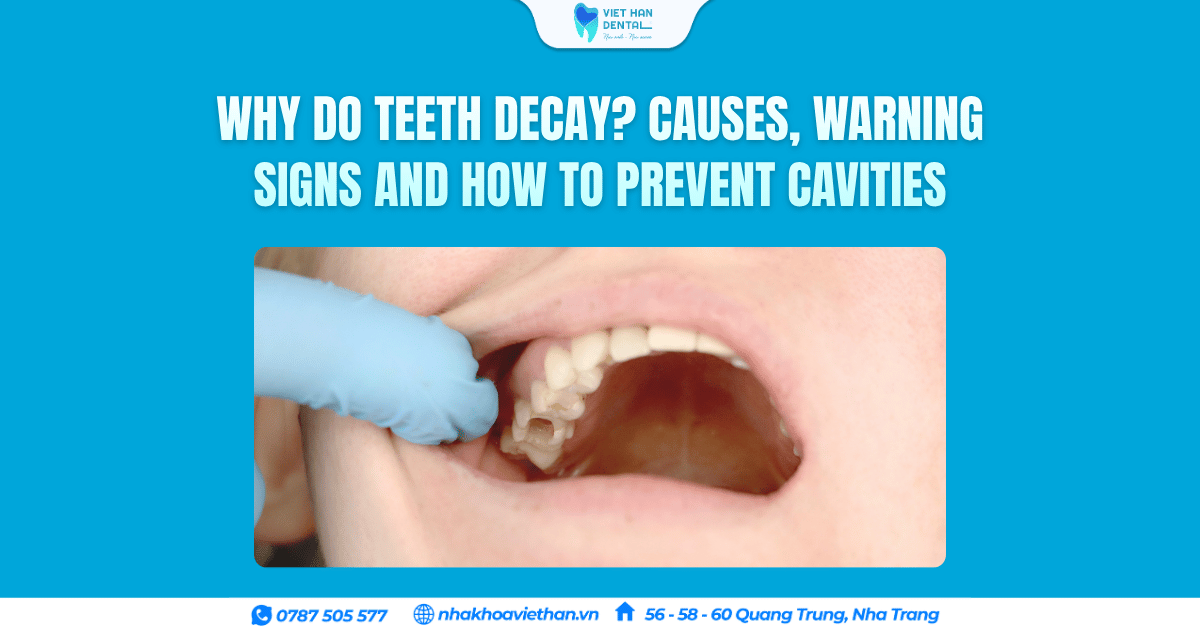
Tooth decay is one of the most common oral health problems, yet it is also one of the conditions that can often be prevented when detected and managed early.
A cavity does not usually appear overnight. Tooth decay develops gradually as the balance inside the mouth shifts in favour of acid-producing bacteria. Over time, repeated acid attacks can weaken the enamel, allowing decay to progress deeper into the tooth.
Understanding why tooth decay happens, what increases your risk and how to recognise the early signs can help you protect your natural teeth for longer.
At Viet Han Dental Clinic in Nha Trang, preventive dental care focuses not only on treating existing cavities but also on identifying the factors that may be contributing to recurrent tooth decay.
Nội dung
- What Is Tooth Decay?
- 1. Plaque Accumulation
- 2. Frequent Sugar Intake
- 3. Inadequate Brushing and Flossing
- 4. Dry Mouth
- 5. Insufficient Fluoride Exposure
- 6. Deep Grooves in Back Teeth
- 7. Crowded or Difficult-to-Clean Teeth
- 8. Acid Reflux and Frequent Acid Exposure
- 9. Existing Dental Restorations
- Stage 1: Early Enamel Demineralisation
- Stage 2: Enamel Cavity
- Stage 3: Dentin Decay
- Stage 4: Pulp Involvement
- Stage 5: Dental Abscess
- Stage 6: Tooth Loss
- Early-Stage Decay
- Dental Fillings
- Inlays, Onlays or Crowns
- Root Canal Treatment
- Tooth Extraction
- Brush Twice a Day
- Use Fluoride Toothpaste
- Clean Between Your Teeth Daily
- Reduce Frequent Snacking
- Maintain Adequate Hydration
- Consider Dental Sealants
- Attend Regular Dental Check-Ups
- Don’t Wait Until a Cavity Starts to Hurt
What Is Tooth Decay?
Tooth decay, also known as dental caries or cavities, is a disease process that causes gradual loss of mineral from the hard tissues of the tooth.
Your mouth naturally contains many different types of bacteria. Some bacteria use sugars and fermentable carbohydrates from food and drinks as an energy source.
During this process, acids are produced.
When these acids repeatedly remain in contact with the teeth, they can remove minerals from the enamel surface. This process is called demineralisation.
In the early stages, the tooth may still be able to recover some of these minerals through saliva and fluoride. However, if acid attacks occur too frequently, mineral loss can eventually exceed the tooth’s ability to repair itself.
A cavity can then develop.
What Causes Tooth Decay?
Tooth decay rarely has a single cause. It usually develops through a combination of oral hygiene, diet, saliva, fluoride exposure and individual risk factors.
1. Plaque Accumulation
Dental plaque is a sticky biofilm that continuously forms on the surfaces of your teeth.
When plaque is not removed effectively through brushing and interdental cleaning, bacteria remain in close contact with the enamel.
After consuming sugar or certain carbohydrates, bacteria inside plaque produce acids.
Repeated acid exposure can gradually weaken the enamel and increase the risk of cavities.
Areas that are particularly difficult to clean can be more vulnerable, including:
- Between teeth
- Deep grooves of molars
- Around the gumline
- Around crowded teeth
- Around braces or other dental appliances
- Around poorly fitting restorations
2. Frequent Sugar Intake
Many people associate cavities with eating sweets, but how often sugar is consumed can be just as important as how much is consumed.
Every time bacteria metabolise sugar, the acidity in the mouth can increase temporarily.
If you frequently snack on sugary foods or sip sweetened drinks throughout the day, the teeth may experience repeated acid attacks with limited time to recover.
Foods and drinks that can contribute to cavity risk include:
- Sweets and confectionery
- Soft drinks
- Sweetened coffee or tea
- Energy drinks
- Sweetened milk beverages
- Biscuits and cakes
- Sticky dried fruits
- Frequent refined-carbohydrate snacks
Reducing the frequency of sugary foods and drinks can be an important step in preventing tooth decay.
3. Inadequate Brushing and Flossing
Brushing removes plaque from accessible tooth surfaces, but a toothbrush may not clean effectively between tightly contacting teeth.
This is why interdental cleaning is also important.
Depending on your dental condition, your dentist may recommend:
- Dental floss
- Interdental brushes
- Water flossers
- Special cleaning tools for braces or dental restorations
Without adequate plaque removal, bacteria have more opportunity to produce acids against the tooth surface.
4. Dry Mouth
Saliva plays a major protective role in oral health.
It helps:
- Wash away food particles
- Neutralise acids
- Provide minerals needed for enamel repair
- Keep oral tissues moist
- Support the natural balance of the mouth
When saliva production decreases, the risk of tooth decay may increase.
Dry mouth, or xerostomia, can be associated with factors such as:
- Certain medications
- Dehydration
- Some medical conditions
- Radiation therapy involving the head or neck
- Mouth breathing
- Reduced salivary gland function
Patients with persistent dry mouth should discuss the condition with their dentist or physician because additional preventive measures may be necessary.
5. Insufficient Fluoride Exposure
Fluoride can help strengthen enamel and support the remineralisation of early areas of mineral loss.
Patients with limited fluoride exposure may have less protection against repeated acid attacks.
For many patients, fluoride toothpaste is an important part of daily cavity prevention.
In higher-risk cases, a dentist may also recommend professional fluoride treatment or other fluoride-containing products.
6. Deep Grooves in Back Teeth
The chewing surfaces of molars and premolars naturally contain pits and grooves.
In some people, these grooves are particularly deep and narrow, making them difficult to clean effectively with a toothbrush.
Food debris and plaque can accumulate in these areas and increase the risk of decay.
Dental sealants may sometimes be recommended to protect these vulnerable surfaces.
7. Crowded or Difficult-to-Clean Teeth
Crowded, rotated or overlapping teeth can create areas where plaque is difficult to remove.
This does not mean that crowded teeth will automatically develop cavities, but maintaining effective oral hygiene may require additional attention.
Your dentist or hygienist can recommend suitable cleaning techniques and interdental tools.
8. Acid Reflux and Frequent Acid Exposure
Stomach acid is highly acidic.
Patients with gastroesophageal reflux disease, frequent vomiting or other conditions involving repeated exposure to stomach acid may experience enamel erosion.
Although erosion and tooth decay are different processes, weakened tooth surfaces may become more vulnerable to further damage.
Frequent consumption of acidic drinks can also contribute to enamel erosion.
Examples include:
- Carbonated soft drinks
- Energy drinks
- Citrus beverages
- Some sports drinks
9. Existing Dental Restorations
Old fillings, crowns or other restorations may eventually develop small gaps, fractures or areas where plaque becomes difficult to remove.
Decay can sometimes develop around the edges of an existing restoration.
This is known as secondary or recurrent caries.
Regular dental examinations help identify these problems before they become more extensive.
What Are the Early Signs of Tooth Decay?
Early tooth decay may cause no pain at all.
This is one reason routine dental examinations are important.
Possible signs can include:
- White, chalky areas on the tooth
- Brown or dark spots
- Visible holes or pits
- Food repeatedly getting trapped in one area
- Sensitivity to cold, sweet or hot foods
- Pain when biting
- Persistent toothache
- Bad breath associated with trapped food or infection
Not every dark spot is a cavity, and not every cavity is visible to the patient.
Some cavities, particularly those between teeth, may require dental X-rays to detect.
What Happens If Tooth Decay Is Left Untreated?
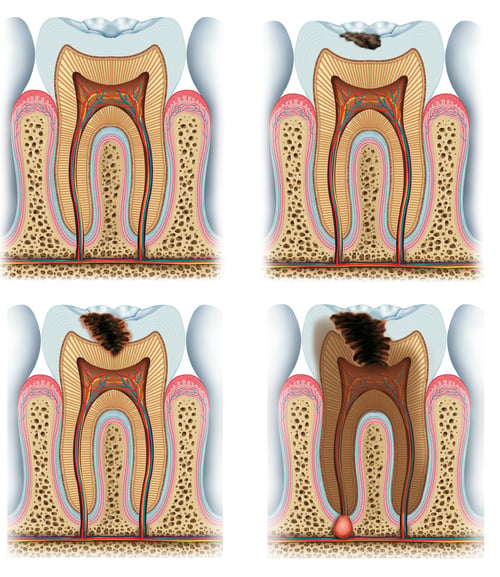
The tooth consists of several layers.
Decay may initially affect the enamel, but if it continues, it can progress deeper.
Stage 1: Early Enamel Demineralisation
The earliest stage may appear as a white or chalky area.
At this point, there may not yet be a physical cavity.
With appropriate oral hygiene, dietary changes and fluoride support, some early lesions may be stabilised or remineralised.
Stage 2: Enamel Cavity
If mineral loss continues, the enamel structure can begin to break down and form a cavity.
Once a physical hole has developed, the tooth generally cannot rebuild that missing structure by itself.
A filling may be required.
Stage 3: Dentin Decay
Underneath the enamel is a softer layer called dentin.
Once decay reaches the dentin, it can progress more quickly.
Patients may begin experiencing sensitivity to cold, sweet foods or pressure.
Stage 4: Pulp Involvement
At the centre of the tooth is the dental pulp, which contains nerves and blood vessels.
If bacteria reach this area, inflammation or infection can develop.
Symptoms may include:
- Spontaneous toothache
- Pain that lingers after hot or cold foods
- Pain when chewing
- Pain that disturbs sleep
Depending on the condition of the tooth, root canal treatment may be required.
Stage 5: Dental Abscess
If infection progresses beyond the tooth, pus can accumulate around the root.
A dental abscess may cause:
- Severe pain
- Gum or facial swelling
- A bad taste in the mouth
- Fever
- Tender lymph nodes
- Difficulty chewing
Dental infections should not be ignored.
Seek professional dental care promptly if you develop facial swelling, fever, difficulty swallowing, difficulty breathing or rapidly worsening symptoms.
Stage 6: Tooth Loss
When a tooth becomes severely damaged and can no longer be predictably restored, extraction may become necessary.
Preventive care and early treatment are therefore important not only for relieving symptoms but also for preserving as much natural tooth structure as possible.
How Is Tooth Decay Treated?
Treatment depends on how far the decay has progressed.
Early-Stage Decay
If there is mineral loss but no structural cavity, the dentist may recommend:
- Improved plaque control
- Fluoride treatment
- Dietary changes
- Increased monitoring
- Management of dry mouth or other risk factors
The objective is to stop or slow the disease process before a filling becomes necessary.
Dental Fillings
When decay has created a cavity but the tooth remains structurally restorable, the damaged tissue can be removed and the tooth restored with a filling material.
The aim is to preserve healthy tooth tissue wherever possible.
Inlays, Onlays or Crowns
When a larger portion of the tooth has been weakened, a simple filling may not provide enough support.
Depending on the amount of remaining tooth structure, the dentist may recommend an indirect restoration such as an inlay, onlay or dental crown.
Root Canal Treatment
If decay reaches the dental pulp and causes irreversible inflammation or infection, root canal treatment may be required to preserve the tooth.
After root canal treatment, some teeth may also require a crown for additional protection.
Tooth Extraction
Extraction is generally considered when a tooth is too extensively damaged to restore predictably or when infection cannot be adequately managed while preserving the tooth.
Whenever possible, treatment planning should aim to preserve natural teeth.
How Can You Prevent Tooth Decay?
The good news is that many cavities can be prevented through consistent daily habits and appropriate professional care.
Brush Twice a Day
Brush your teeth at least twice daily using a soft-bristled toothbrush.
Pay particular attention to:
- The gumline
- Back molars
- Inner tooth surfaces
- Areas around restorations
- Areas that are difficult to reach
Electric and manual toothbrushes can both be effective when used correctly.
Use Fluoride Toothpaste
Fluoride toothpaste can help strengthen enamel and make the teeth more resistant to acid attacks.
After brushing, avoid immediately rinsing the mouth excessively with water, as this can reduce the amount of fluoride remaining on the teeth.
Your dentist can recommend an appropriate fluoride concentration based on your age and individual risk.
Clean Between Your Teeth Daily
Many cavities develop between teeth where toothbrush bristles cannot reach effectively.
Daily flossing or interdental cleaning helps remove plaque from these areas.
The appropriate method depends on the spaces between your teeth and your dental condition.
Reduce Frequent Snacking
Rather than continuously exposing your teeth to sugar throughout the day, try to keep sweet foods and drinks to regular mealtimes whenever possible.
Water is generally the best choice between meals.
Reducing frequent sugar exposure allows saliva more time to neutralise acids and support remineralisation.
Maintain Adequate Hydration
Drinking water helps support normal saliva production and can help rinse away food particles.
This is particularly important for patients who frequently experience dry mouth.
Consider Dental Sealants
Dental sealants are thin protective coatings placed over the chewing grooves of susceptible teeth.
They are commonly used in children and teenagers but may also be appropriate for some adults with deep grooves and a high risk of decay.
Your dentist can assess whether sealants would be beneficial.
Attend Regular Dental Check-Ups
A cavity is much easier to manage when detected early.
Routine dental examinations allow your dentist to identify:
- Early enamel changes
- Hidden cavities
- Decay between teeth
- Failing fillings
- Gum problems
- Areas of difficult plaque control
The frequency of check-ups should be based on your individual oral health risk rather than following exactly the same schedule for every patient.
Professional Dental Cleaning and Cavity Prevention
Even with good home care, plaque may accumulate in areas that are difficult to reach.
Over time, plaque can mineralise into tartar, which cannot be removed completely with a normal toothbrush.
Professional cleaning helps remove plaque, tartar and deposits from around the teeth and gumline.
During the appointment, the dental team can also identify areas where your brushing technique may need improvement and provide personalised hygiene guidance.
Why Do Some People Keep Getting Cavities?
Some patients develop new cavities despite brushing regularly.
This can happen because cavity risk is influenced by much more than brushing alone.
Possible contributing factors include:
- Frequent sugary drinks
- Constant snacking
- Dry mouth
- Inadequate interdental cleaning
- Deep tooth grooves
- Orthodontic appliances
- Existing restorations
- High levels of plaque
- Limited fluoride exposure
- Certain medications
- Acid reflux
- Difficulty reaching certain areas of the mouth
If you repeatedly develop cavities, simply treating each new hole may not be enough.
The underlying risk factors should also be identified and managed.
Tooth Decay Prevention at Viet Han Dental Clinic in Nha Trang
At Viet Han Dental Clinic, our approach to cavity management begins with identifying both the existing damage and the factors contributing to it.
Depending on your individual condition, your dental visit may include:
- Comprehensive oral examination
- Dental X-rays when clinically indicated
- Professional teeth cleaning
- Assessment of existing fillings and restorations
- Fluoride treatment where appropriate
- Dietary and oral hygiene advice
- Dental sealants for suitable cases
- Tooth-coloured fillings
- Root canal treatment when necessary
- Restorative treatment for extensively damaged teeth
Our priority is to detect dental problems early and preserve as much healthy natural tooth structure as possible.
Don’t Wait Until a Cavity Starts to Hurt
One of the biggest misconceptions about tooth decay is that you will always feel pain when something is wrong.
In reality, cavities can grow silently for a considerable period of time.
By the time a tooth starts hurting, decay may already have reached deeper layers.
Regular check-ups are therefore one of the simplest ways to detect problems before they become more complicated.
If you have noticed tooth sensitivity, dark spots, food trapping, a broken filling or persistent tooth discomfort, it may be time to have the area examined.
Viet Han Dental Clinic – Nha Trang
56–58–60 Quang Trung, Nha Trang, Vietnam
Hotline / WhatsApp: +84 787 505 577
Website: nhakhoaviethan.vn